

The internet? What's that for?
It's hard to believe that the first widely used Internet browser, Netscape Navigator, debuted in 1994, only 24 years ago. Netscape was a huge success, bringing the internet to a much wider audience than had previously engaged with the world wide web, but for much of the '90s the internet remained a niche curiosity, with only a small group of tech-savvy individuals grasping its potential. How things have changed.
Netscape is no longer with us, notwithstanding its code descendant in Mozilla Firefox, but in the intervening years the internet has gone from a niche curiosity to arguably the most important force shaping human civilization today. Anyone under the age of 30, such as myself, has largely grown up with the internet, and those under the age of 20 can't remember a time before its ubiquity. We are 24 years from the release of Netscape, 12 years since Facebook became available to the general public, 11 years post-iPhone, and still in the early days of Artificial Intelligence and blockchain.
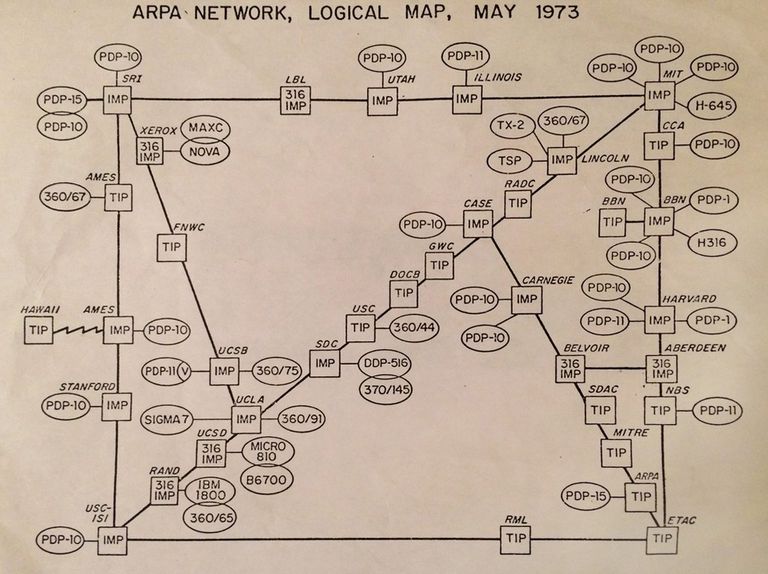 Arpanet: the origins of the internet.
We have lift-off
The past quarter century has seen technological advancement at a breakneck pace, and, more importantly, the incredible integration of these technological advances into our daily lives. What I mean by this, is that while domains such as theoretical physics or advanced mathematics may have seen some incredible advances, these do not affect us in a direct way on a daily basis. The internet, on the other hand, along with the proliferation of devices and applications connected to it, has fundamentally reshaped society. It is rare for anyone anywhere on the planet to go a day without interacting with the internet in one form or another.
Email, social media, smart phones, online banking, dating apps, Wikipedia - the internet in its various manifestations define our daily activities.
Note : I am perhaps being sloppy in my terminology by referring to all of the various technologies related to the internet as some sort of monolithic technological innovation, but for convenience and for the purpose of this article I will for the most part eschew specificity regarding the distinctions between all of these various technologies. I merely use the "internet" as short hand for the variety of innovations that are closely linked to, or consequences of, the world wide web.
 The Marea transatlantic internet cable.
Philosopher kings of the internet age?
This rapid transformation into a technological civilization however, has not been accompanied with an equivalent increase in general technological understanding and knowledge. A chasm has opened up between the technological reality of modern civilization and general comprehension of this technology. Only a small minority have even a basic grasp of the devices and protocols that now define and shape our lives, and as the internet and related technologies become more and more integral to society, this void of miscomprehension becomes ever more important and problematic.
A very small subset of humanity - software engineers, computer scientists, mathematicians - understand the concepts and ideas that underlie the internet, and among these technical experts there is an even smaller subset who are truly intrigued by and concerned about the societal consequences of the technological revolution of which we are in the midst. Crucially, however, those individuals such as legislators, lawyers, and corporate executives who tend to be concerned with, and responsible for, shaping society have, for the most part, little or no understanding of the technological forces that are now driving human history.
 Jeff Bezos, Larry Page, Sheryl Sandberg, alongside President Trump
and Vice President Pence
This void of misunderstanding between society and the technological forces shaping it is different than with many previous eras of scientific and technological advances. Take the automobile for example. There is no question that fossil fuel powered automobiles were a transformative technological innovation, but while it may be useful to understand how a car functions, it is not necessary to understand an internal combustion engine in order to effectively apprehend what the consequences of motorized vehicles are for society.
This is completely different with the internet, social media, smart phones, AI, and blockchain. Not only are these technologies extremely complex (far more complex than an internal combustion engine), but their disruptive impact on society is also intricately complicated. Furthermore, I posit that it is impossible to understand their effect on human civilization without having a sophisticated understanding of the underlying technology. Unlike with an automobile, it is far from straightforward to comprehend what the internet can be used for, and therefore to understand how it should be used. The transformative nature of something like the internet is infinitely complex.
Who will do the thinking?
The fallout of this is that legislators, thinkers, lawyers, business people, activists, and the vast majority of society are ill-equipped, or often completely unequipped, to comprehend and harness the transformative nature of the internet. A vivid example of this legislative incomprehension was Mark Zuckerberg's recent Congressional testimony. Zuckerberg appeared before the Judiciary and Senate Committee on Commerce, Science, and Transportation to answers questions on "Facebook, Social Media Privacy, and the Use and Abuse of Data". The hearing is a frightening display of confusion and miscomprehension, clearly evincing the complete inability of American legislators to provide any sort of meaningful and useful regulation to internet related industries. Among the questions Zuckerberg was asked were:
1) "How do you sustain a business model in which users don't pay for your service?" - 84 year old Republican Senator Orrin Hatch
2) "And did you know that the Motion Picture Association of America is having problems with piracy of movies and of their products and that not only is this challenging their profits, but their very existence?" - Republican Congressman Buddy Carter
3) "If I'm emailing within WhatsApp, does that ever inform your advertisers?" - Democratic Senator Brian Schatz
Some highlights of the testimony can be found here.
It is tempting to ascribe this ignorance to the generational gap - the average age of the United States Senate is 61 - but the reality is that while the generation that grew up with the internet may be more savvy users of social media, the vast majority do not understand the technology at even a basic level, and therefore are incapable of comprehending the significance and consequences of the internet. This was painfully clear in the wake of the revelations that the NSA and other security establishments around the world are collecting and using enormous amounts of data on us, thanks to Edward Snowden's whistleblowing. What should have been viewed as one of the most egregious violations of privacy, legislative trust, and civil liberties in recent memory was instead met with indifference.
The consequences of this chasm of misunderstanding are vast, and they will become more apparent and severe as the world is continually shaped by technological forces.