
So many terms, but what do they mean?
This post was originally written as an attempt to explain AI and deep learning to managers at a previous job where I was working as a data scientist. There was an extraordinary amount of hype over "AI" and an even more extraordinary lack of understanding of what various terms mean or where they come from.
Artificial Intelligence, machine learning, deep learning – these terms probably sound familiar to you, but what do they actually mean? In only a couple of years, words that used to be sole domain of computer science and math departments, or lunch rooms at tech companies, have found their way into the everyday lexicon of the average person. The catch is, while it is now common to hear these words on the news, or read them in the newspaper, most people don’t really know what they mean. There is a lot of confusion and uncertainty around what AI is, and what machine learning and deep learning have to do with it. This post will attempt to clear up some of that confusion, and demystify these terms by putting them on a more solid definitional footing, without getting too deep into the weeds.
What we choose to refer to as artificial intelligence is somewhat arbitrary. For example, very few people would consider a calculator correctly summing two numbers as artificial intelligence, but most people would say facial recognition technology is artificial intelligence. This distinction isn’t made because of inherent differences in the algorithms responsible for executing the summation and identifying a face, but rather because we have become accustomed to computers adding numbers. Facial recognition on the other hand feels like a much more novel accomplishment, and also most of us would consider recognizing a face to be somehow a more “human” task than performing arithmetic.
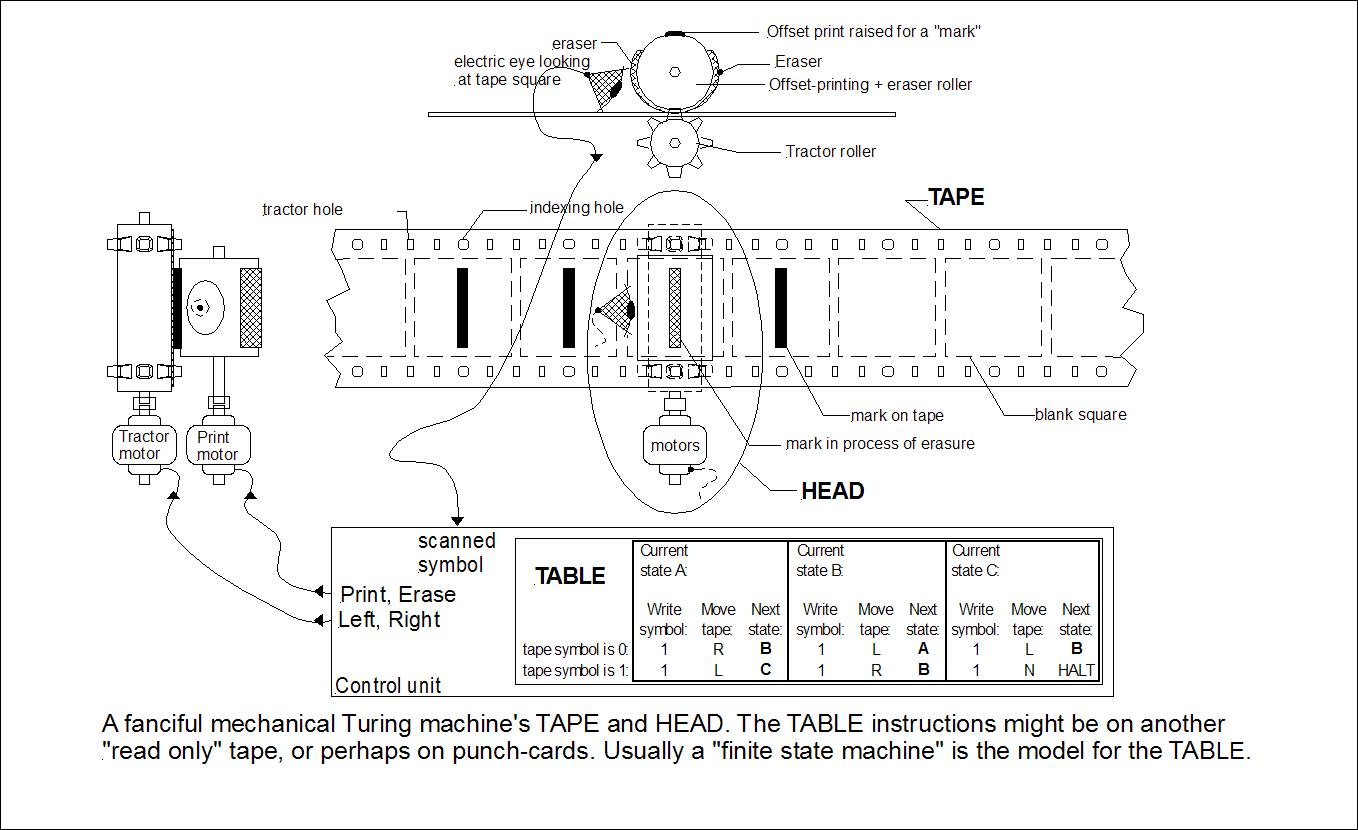 An example of early AI: a Turing machine.
A computer successfully adding two numbers together is clearly an example of a machine performing what in human beings is a cognitive task, but, for the most part, when people talk about artificial intelligence, they are not referring to this kind of phenomenon. While it varies depending on who you are talking to, I think it is fair to say that what is considered artificial intelligence tends to be non-deterministic processes, that up until recently, computers were not very good at, and that seem to closely resemble what we generally think of as human thinking processes. This is perhaps a bit of a bulky definition, but I think it provides a somewhat accurate reflection of the inexact and shifting contours of what is meant by artificial intelligence.
Machine learning, on the other hand, is a well-defined term in the realm of computer science. Machine learning generally refers to algorithms that allow a computer to learn from seeing examples of data. Wikipedia defines machine learning as “a subset of artificial intelligence in the field of computer science that often uses statistical techniques to give computers the ability to "learn" (i.e., progressively improve performance on a specific task) with data, without being explicitly programmed.” The majority of what we consider to be artificial intelligence today is driven by machine learning. Artificial intelligence can also come in the form of rules or logic based algorithms (the addition of two numbers is in fact an example of this) that do not learn from data, but rather execute decisions based on following logical rules. Many full-scale AI solutions contain a component of logic based rules, but in the current AI revolution there has been a move towards allowing machines to learn on their own, and away from human designed rules or guidelines.
Finally, we have deep learning. Deep learning is a subset of machine learning, and refers to a class of algorithms vaguely inspired by biological nervous systems and brains. The base algorithm of most deep learning models is the artificial neural network, the development of which was inspired by the biological neural networks found in our brains. Deep learning models attempt to learn multiple levels of representations of the data that generally correspond to a hierarchy of concepts. It is worth remembering that while machine learning algorithms are often described via metaphor and analogy, the only truly accurate descriptions of what these models do is a mathematical one as they function by performing mathematical operations on numerical representations of data. Deep learning models have been wildly successful in recent years, and are largely responsible or driving the recent boom in AI. When you hear about some incredible new breakthrough in AI, it’s probably a deep learning model that has achieved it.
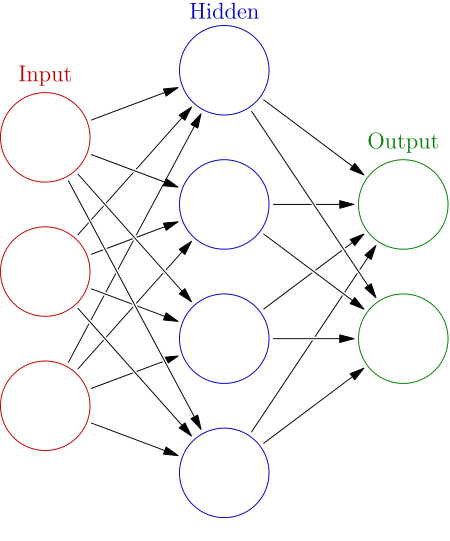 A simple neural network with one hidden layer.
Artificial Intelligence is not new
For many of us, the past couple of years are the first time we have regularly heard about artificial intelligence outside of science fiction and Hollywood movies, but, surprisingly, most of these ideas are not new. Modern computers have of course been around since the 1950s, and the first algorithm was actually written by Ada Lovelace in the 1840s to calculate Bernoulli numbers.
Similarly, machine learning is not a new concept. The term machine learning was coined in 1959 by Arthur Samuel, but even this was just a formalization of concepts that had already been around for a while. Many people have actually had exposure to machine learning models, and perhaps implemented machine learning models themselves without realizing it. For instance, linear and logistic regression are examples of machine learning algorithms, although they are rarely referred to as such.
 Ada Lovelace.
Even deep learning is not new. Artificial neural networks have been around for decades, and while many of the core ideas and refinements that have enabled the recent success of deep learning are slightly more recent, they certainly have not arrived in the past two years. In fact, many are more than 10 or 20 years old. Interestingly, a handful of Canadian academics are some of the foremost pioneers in the realm of deep learning, and, largely because of their influence, Canada has a disproportionately large presence in the world of AI. American tech giants are populated with graduates of Canadian universities, helping to drive their AI research forward. Université de Montréal and Mcgill (MILA in particular), the University of Toronto, and the University of Alberta have some of the strongest researchers in machine learning in the entire world. To name a few academics and industry leaders with strong Canadian connections: Yoshua Bengio, Geoffrey Hinton, Yann LeCun, Richard Sutton, Ilya Sutskever, and Andrej Karpathy. By no means does Canada occupy some sort of special place in the world of machine learning, but as a Canadian I find it interesting to see that Canada is home to some of the academic leaders who helped spark the deep learning revolution. Furthermore, it goes without saying that many of the intellectual leaders in the realm of machine learning are not Canadian, and of course many of the students and professors at Canadian Universities come from all over the world.
So why does it seem like AI is this brand new thing?
The short answer to this question is that a lot of these techniques have only recently started to be truly effective. This of course begs the question as to why they have only started working well in the past few years, and the answer to this is mainly improved computational power, and much much more data. In order to “learn”, deep learning algorithms must perform an enormous number of computations, and this number of computations increases with the size and complexity of the deep learning model in question.
Machine learning models are implemented by writing code, and this code can be written so as to optimize computational processes to be as efficient as possible, but this optimization only takes you so far – eventually it’s up to the hardware to do the actual computations. By an interesting turn of fate, the video game industry actually laid the groundwork for this piece of the puzzle. For decades, enormous sums of money have been invested in improving graphics processing units (GPUs) in order to allow machines to render increasingly complex video game graphics. Interestingly, the math that is required to render video game graphics (namely, matrix multiplication) is more or less the same math needed to train deep learning algorithms, and thanks to years of investment in creating hardware optimized to perform these computations, modern GPUs are extremely efficient at doing this math. While you are less likely to hear about them, chipmakers, and NVIDIA in particular, have played a huge role in driving the AI boom. The appetite for increased specialized computational power is accelerating advances in this field, with companies like Google, Facebook, and Apple all recently developing their own versions of GPUs in order to run their deep learning models and decrease reliance on their competitors.
An interesting side note here is that GPUs are not only the essential piece of hardware for training deep learning models, but much of the mining of cryptocurrencies is also performed with GPUs – either NVIDIA GPUs, or, in some cases, specialized hardware known as application-specific integrated circuits (ASICs). In short, if you bought NVIDIA stock 5 years ago you probably feel pretty good about yourself right now.
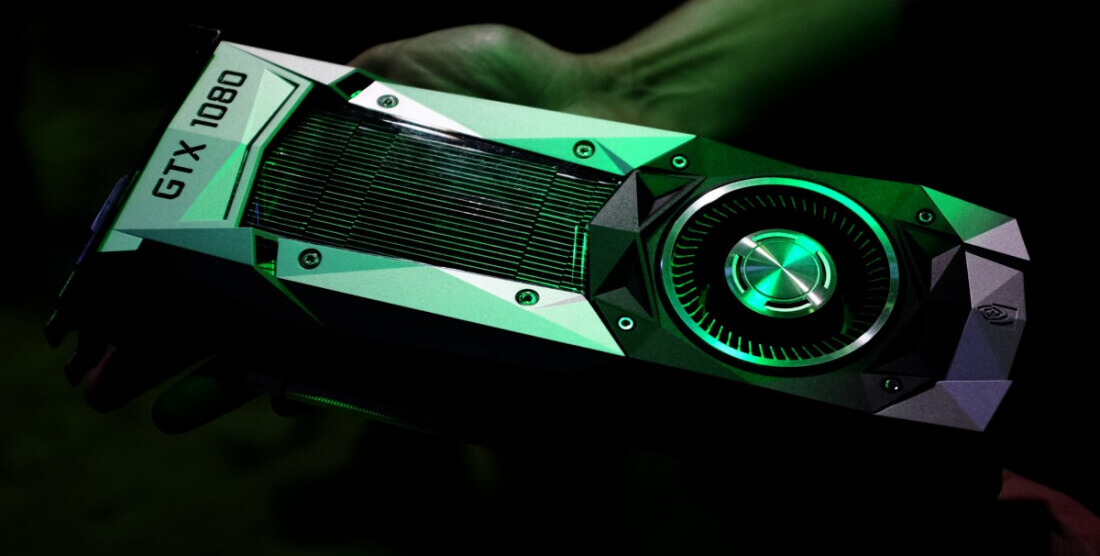 An NVIDIA GTX 1080 GPU.
The other big piece of the puzzle leading to the success of deep learning algorithms is the availability of data. One feature that sets deep learning models apart from other machine learning models is that they tend to keep getting better and better the more data they see, whereas the effectiveness of many traditional machine learning methods plateaus relatively quickly as the amount of data used to train them increases. Thanks to the digitization of vast quantities of the world’s information, and the unprecedented creation of new data thanks to internet based applications and companies, there is now vastly more data available for machine learning algorithms to be trained on than was the case 10 to 15 years ago.
This trend is also certainly not going away. With the advent of the Internet of Things (i.e. appliances, cars, and other items with devices embedded in them enabling them to connect to the internet and share data), and the ineluctable transition to digital, internet based platforms, the amount of data created on a daily basis will continue to soar to staggering volumes, creating an environment in which AI algorithms will continually improve and solve ever more complicated tasks.
What, exactly, can AI do?
Along with the confusion over what is meant by terms like artificial intelligence, machine learning, and deep learning, is a lack of clarity on what state of the art machine learning algorithms can actually do, and what they are used for. On one end of the spectrum is the idea that we are on the verge of artificial general intelligence, and AI is a hugely dangerous and destabilizing force that we will be unable to control – a veritable Pandora’s Box. On the other end of the spectrum are those that think AI is all hype, and that it is not being used for anything useful, nor has it truly had any successes. Unsurprisingly, neither of these two points of view provides a very accurate depiction of the current state of artificial intelligence and machine learning.
Machine learning algorithms can be used on a wide variety of different data types, and have recently been very successful when applied to data types and tasks that have traditionally been outside of the scope of machines’ abilities to do much with. For example, deep learning algorithms have proved to be extremely successful at performing image recognition tasks, in fact, often far better than humans on specific tasks. For example, ImageNet is an online database with over 14 million annotated/labelled images spread across over 20 thousand categories. There is an annual competition to identify the correct categories of these images using machine learning techniques, and starting in 2012 deep learning models began shattering the previous best results. The competition involves only one thousand out of the 20 thousand categories, but state of the art deep learning models now achieve staggeringly low error rates on this dataset.
Machine learning algorithms can also be used to analyze natural language. Using machines to perform analysis on natural language is not necessarily a recent phenomenon, but in recent years the efficacy of machine learning algorithms in this area has increased markedly. For example, a machine learning algorithm can be trained to identify hate speech, or to extract the names of people and entities in a document. Deep learning has been very effective at improving capabilities at working with textual data, known as Natural Language Processing (NLP), but I think it is fair to say that its capabilities remain somewhat more limited in NLP compared to image processing.
Machine learning can of course also be used on more familiar structured datasets, such as economic data. For example, machine learning algorithms can be, and are, employed to predict prices in financial markets based on past prices and other input data. Google has touted their use of deep learning to analyze data related to the cooling of their server farms to achieve an astounding 40% reduction on their data centre cooling bill.
The list of examples of real or potential applications of machine learning is infinite, and it is a fool’s errand to try to provide an exhaustive catalogue of use cases, but, that being said, I think it is helpful to provide some concrete examples with the aim of reifying the rather more abstract categories of application mentioned above.
Text Categorization:
There are many situations in which large organisations and governments receive large quantities of textual data, and must separate this text into different categories. For example, many organisations monitor articles written in the media in order to understand how the public feels about the organisation, or how certain actions or policies are perceived in the media. This task involves identifying articles that are relevant to the organisation from the vast quantity of print media produced everyday. Lists of keywords combined with Boolean logic (e.g. “smart phone” AND NOT “iPhone”) can help to identify the articles of interest, but this approach is quite limited in its efficacy. On the other hand, if you have historical examples of which articles are important and unimportant for the organization, you can train a machine learning algorithm to learn to recognize the important articles and identify them automatically. This type of task is not limited to identifying important news articles, but can be applied in any situation involving the categorization or classification of textual data.
Chat-bots:
Another very useful application of AI is the creation of chat-bots, or virtual assistants. Chat-bots are virtual question answering tools that can help customers find information and answers without having to interact with a human agent or execute tasks, such as making an online purchase. Chat-bots vary in their sophistication, but if they are able to provide relevant information to customers or clients it is easy to see how useful they can be.
Recommender Systems:
Recommender systems are used to recommend products, services, or really anything to clients or customers. For example, Amazon and Netflix both leverage recommender systems as integral pieces of their business. Amazon of course uses recommender systems to suggest products for customers to purchase, while Netflix uses them to suggest shows and movies to watch.
Whether or not you know it, you are interacting with AI algorithms on a daily basis. When your phone suggests the next word in a sentence, or autocorrects a misspelled word, there are machine learning algorithms running in the background. When you use Netflix, Amazon, or Facebook there are myriad machine learning algorithms working to suggest interesting movies, products, or advertisements to you. In fact, most social media websites and applications are continuously using AI to determine how best to encourage users to spend more time on their site or application. Even the United States Postal Service and Canada Post use AI to read addresses and postal codes from envelopes.
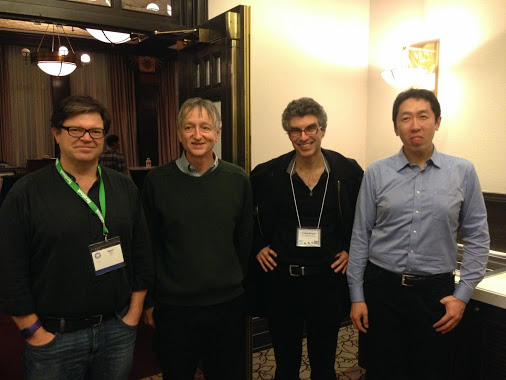 Left to right: Yann LeCun, Geoffrey Hinton, Yoshua Bengio,
and Andrew Ng (from Andrew Ng's Facebook page).
As these examples demonstrate, artificial intelligence is already enjoying widespread use, and investments into AI are paying dividends on a daily basis. Despite this, however, the type of AI we have today does not bear even a remote semblance to the kind of artificial general intelligence portrayed in science fiction. Today’s AI algorithms have become very good at solving some narrowly defined, highly restricted problems, but they have nothing resembling any kind of general intelligence. Even Google’s remarkably impressive and frightening new Google Assistant from their Duplex project is actually very limited in what it is capable of doing.
The virtual assistant’s uncanny ability to mimic human speech patterns and carry on a relatively complex conversation gives the impression that it truly understands the conversation it is engaging in, and makes it appear that it possesses some kind of general intelligence (if you haven’t seen it in action, I recommend checking out this video or the blog hyperlinked above). The reality is, however, that while the Duplex project is an incredible achievement, combining a variety of state of the art algorithms and feeding them enormous amounts of data to learn from, the assistant is actually quite limited in the scope of what it is capable of doing. It can book appointments and make reservations, but it does not possess any ability to “think on its own” and certainly won’t be plotting the destruction of humanity any time soon.
This article has avoided going into any kind of technical details as to how these AI and machine learning algorithms work, and I have intentionally left out many important details for understanding the current state of AI, but in order to keep the length reasonable, certain editorial decisions had to be made. To sum things up, artificial intelligence, machine learning, and deep learning are not necessarily the same thing, but whether or not they know it, most people are actually talking about deep learning, and almost certainly talking about machine learning, when they talk about AI; the current AI revolution has probably been driven more by advances in processing power and data availability than by algorithmic innovation; and while we may not be close to building artificial general intelligence yet, the state of the art in AI already has many extremely effective applications.