Note that this is the first post in a three-part series on cryptography. The second post on Security is here, and the third, on NTRU, is here. This series of posts was originally written as part of a summer research project under the supervision of Dr. Anne Broadbent and Dr. Raza Kazmi at the University of Ottawa.
What is Cryptography?
Cryptography, as defined by the Oxford English Dictionary, is "the art of writing and solving codes”. As Katz and Lindell note in [6] this is historically accurate, but with advent of rigorous modern cryptography in the 1970s and 1980s, cryptography is more a science than an art today. Cryptography refers to the twin branches of cryptology and cryptanalysis. Cryptology is the process of encrypting information, whereas cryptanalysis refers to attempts to decrypt information. Cryptography is a very old idea and has existed in various forms for thousands of years. At its core, cryptography is the art or science of sending secret messages between two parties, so that a third party cannot decipher the message even if they were to intercept the message. In [12], Douglas Stinson writes "The fundamental objective of cryptography is to enable two people, usually referred to as Alice and Bob, to communicate over an insecure channel in such a way that an opponent, Oscar, cannot understand what is being said."
In the past, cryptography was essential for sending secret messages containing sensitive information. For example, during times of war, cryptography was used to send sensitive information that could potentially be intercepted by the enemy. A famous historical example of encryption in use is the German Enigma machine during the Second World War, whose cipher was eventually broken by Alan Turing and his colleagues at Bletchley Park. In the modern digital and internet age, cryptography has become more important than ever before, as we are constantly sending sensitive information over insecure channels.
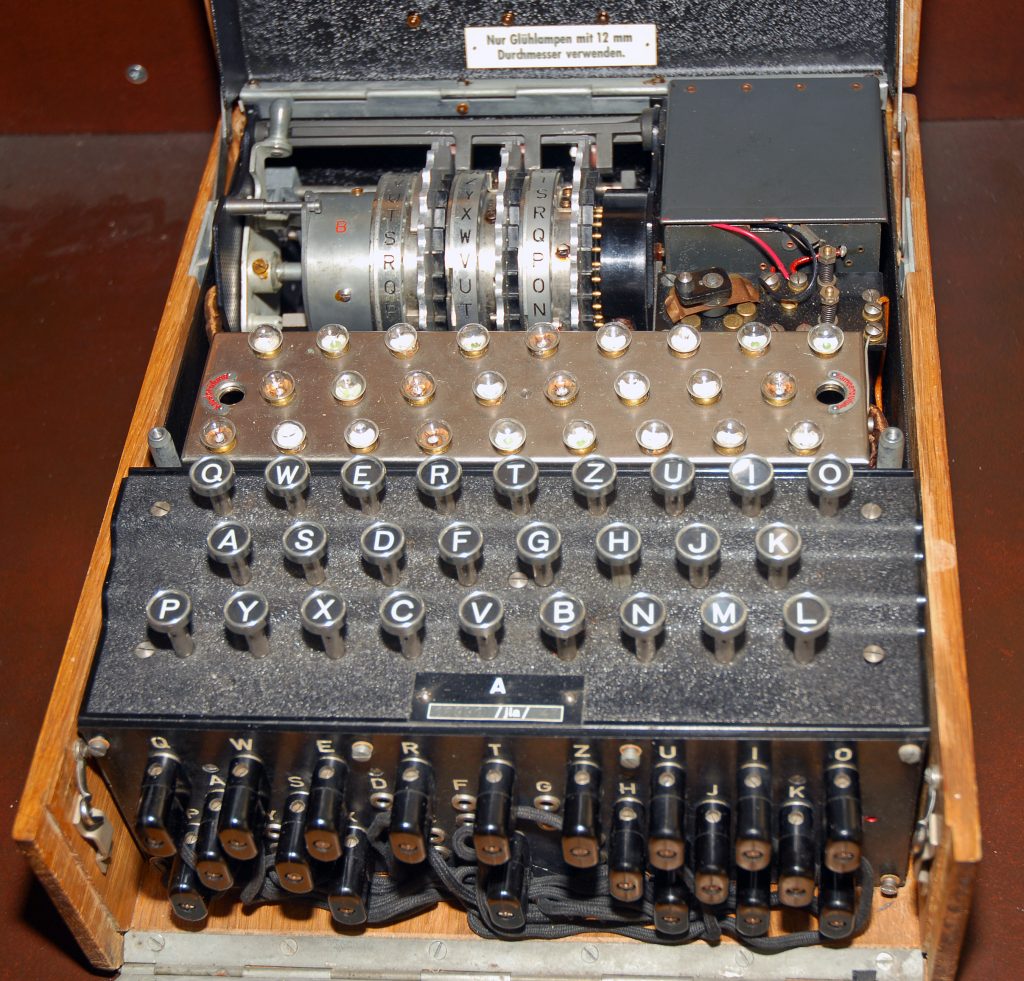 The Enigma machine. The robust encryption of messages, and the eventual breaking of
the enigma cipher were hugely important to the war effort on both sides.
On a daily basis, most of the world relies on the information security cryptography provides without even being aware of it. For example, online banking, emails, and credit card purchases must all be encrypted to prevent third parties from stealing one's information. This increase in the scope of cryptographic applications motivates the general definition of cryptography given in [6] "[Cryptography is] the scientific study of techniques for securing digital information, transactions, and distributed computation.”
In our scenario with Alice, Bob, and Oscar, the unencrypted message or information that Alice wants to send to Bob is referred to as plaintext, while the encrypted message is known as ciphertext. The plaintext is encrypted using a key, and is sent to Bob who is able to decrypt the ciphertext as he knows the encryption key. If the ciphertext is intercepted by Oscar, he will be unable to decrypt the message as he does not know the encryption key.
Formally we can define a cryptosystem as follows.
Definition (Cryptosystem) A cryptosystem is a five-tuple $\mathcal{(P,C,K,E,D)}$, where the following conditions are satisfied:
- $\mathcal{P}$ is a finite set of possible plaintexts.
- $\mathcal{C}$ is a finite set of possible ciphertexts.
- $\mathcal{K}$, the keyspace, is a finite set of possible keys.
- For each $k \in \mathcal{K}$, there is an encryption rule $e_k \in \mathcal{E}$ and a corresponding decryption rule $d_k \in \mathcal{D}$. Each $e_k: \mathcal{P} \to \mathcal{C}$ and $d_k: \mathcal{C} \to \mathcal{P}$ are functions such that $d_k(e_k(x))=x$ for every plaintext element $x \in \mathcal{P}.$
Modern cryptography is an intersection of computer science and mathematics. One can approach cryptography from a more mathematical perspective, or a perspective informed more from computer science. As a result, there are different vocabularies and ways of presenting information, that may seem more or less intuitive depending on one's background. The above definition is drawn from a more mathematical perspective, so an alternative computer science-centric definition can also be given. The following definition is in fact the commonly accepted definition of a cryptosystem in modern cryptography, but it is perhaps less familiar to students coming from a mathematical background.
Definition (Alternate definition of a cryptosystem) A cryptosystem is a 3-tuple of algorithms, $\Pi=(\texttt{keyGen}, \texttt{Enc}, \texttt{Dec})$ with the following properties:
- The key-generation algorithm $\texttt{keyGen}(1^{\lambda})$ ($\lambda$ being the security parameter) is a probabilistic algorithm that outputs a key $k \in \mathcal{K}$ chosen according to some distribution that is determined by the scheme.
- The encryption algorithm $\texttt{Enc}$ takes as input a key $k$ and a plaintext $m \in \mathcal{P}$ and outputs a ciphertext $c \in \mathcal{C}$. We denote the encryption of the plaintext $m$ using the key $k$ by $\texttt{Enc}_k(m)$.
- The decryption algorithm $\texttt{Dec}$ takes as input a key $k$ and a ciphertext $c$ and outputs a plaintext $m$. We denote the decryption of the ciphertext $c$ using the key $k$ by $\texttt{Dec}_k(c)$.
Here, $\mathcal{K}$ is the keyspace, $\mathcal{P}$ is the set of possible plaintexts, and $\mathcal{C}$ is the set of possible ciphertexts. An encryption scheme is fully defined by specifying the three algorithms ($\texttt{keyGen}$; $\texttt{Enc}$; $\texttt{Dec}$) and the plaintext space $\mathcal{P}$. In order for the encryption scheme to function properly, we require that for every key $k$ output by $\texttt{keyGen}$ and every plaintext $m \in \mathcal{P}$, it holds that $$\texttt{Dec}_k(\texttt{Enc}_k(m))=m.$$ The two definitions of a cryptosystem given above actually define a $\textit{private-key}$ or $\textit{symmetric}$ cryptosystem, however they can easily be modified to define a $\textit{public-key}$ or $\textit{asymmetric}$ cryptosystem as we will discuss later.
While the definition of a cryptosystem is not particularly involved or complex, it does not make it clear what an encryption scheme might look like in practice, so we provide a couple of examples of simple encryption schemes borrowed from [12] to help reify our discussion thus far.
Cryptosystem 1 Shift Cipher
Let $\mathcal{P=K=C}=\mathbb{Z}_{26}$. For $0 \le k \le 25$, define
$$ e_k(x)=(x+k) \ mod \ 26 $$
and
$$ d_k(y)=(y-k) \ mod \ 26 $$
$(x,y \in \mathbb{Z}_{26}).$
Cryptosystem 2 Substitution Cipher
Let $\mathcal{P=C}=\mathbb{Z}_{26}$. $\mathcal{K}$ consists of all possible permutations of the 26 symbols $0,1,\ldots,25$. For each permutation
$\pi \in \mathcal{K}$, define
$$ e_{\pi}(x)=\pi(x), $$
and define
$$ d_{\pi}(y)=\pi^{-1}(y), $$
where $\pi^{-1}$ is the inverse permutation to $\pi$.
In the Shift Cipher, our plaintext space, keyspace, and ciphertext space are all $\mathbb{Z}_{26}$. To encrypt a message we take a letter $x$ from our plaintext and add our key $k$ to it modulo 26. The resulting ciphertext has therefore been ``shifted". We provide an example to illustrate. Suppose the key for our shift cipher is $k=13$ and we have the plaintext $$iamacat$$ which we want to encrypt. First we convert the letters into numbers modulo 26 so our encryption key can take them as input. For our plaintext we have: $$8 \ 0 \ 12 \ 0 \ 3 \ 0 \ 19$$ Now we apply our encryption algorithm by adding 13 to each value and reducing each sum modulo 26. Doing this we obtain: $$21 \ 13 \ 25 \ 13 \ 16 \ 13 \ 6$$ To obtain our ciphertext, we now convert our numbers back to letters $$vnznqng$$ Hence Alice would send "vnznqng" to Bob. Upon receiving this ciphertext, Bob could decrypt the message to read the original "iamacat". If Oscar intercepts the ciphertext he will not be able to decrypt it unless he knows the key, $k$. Clearly this cryptosystem is not very secure, as it would not be difficult for Oscar to determine $k$ by merely exhaustively trying all the integers $0 \le k \le 25$.
The Shift Cipher is actually a special case of the substitution cipher, as it contains only 26 of the possible $26!$ permutations of 26 elements. The number of possible permutations, $26!$, is a very large number, so an exhaustive search for the key is infeasible. The Substitution Cipher is therefore more secure than the Shift Cipher, but there are other methods than an exhaustive search to break the cryptosystem (see [12]) that we will not discuss here. An encryption scheme's security depends on more than an attacker being able to recover the encryption key, and we will provide a more detailed discussion of cryptographic security later in a future post in this series. The two cryptosystems presented above can be used to convert Roman alphabet plaintexts into ciphertexts. Clearly modern day cryptography encompasses more than just sending secret messages, and the cryptosystems that are widely used today are more complex than these two toy examples. That being said, shift and substitution ciphers have been used many times throughout history, and before the invention of computers, cryptanalysing a well implemented substitution cipher would have been no trivial task.
Public-Key Cryptography
As we mentioned earlier, the theory of cryptography took a decisive turn in the 1970s and 1980s. The theoretical revolution in cryptography was largely sparked by a 1976 paper by Diffie and Hellman titled "New Directions in Cryptography." This paper introduced several new ideas that would become central to the study of cryptography for the next several decades. For the purposes of this post, the most important concept Diffie and Hellman introduced was that of $\textit{public-key}$ or $\textit{asymmetric}$ cryptography.
In our earlier definitions and examples of encryption schemes, both Alice and Bob shared the same key that could be used to both encrypt and decrypt messages. This is certainly an effective method of designing a cryptosystem, but its security requires that the key be kept secret from hostile third parties such as Oscar. As Alice and Bob both use the same key, and this key must be kept secret, this kind of cryptosystem is called a private-key or symmetric encryption scheme. A private-key cryptosystem requires that Alice and Bob have a secure channel in which they can share the key before they start communicating over an insecure channel. For many cryptographic purposes a private-key scheme poses no problems. For example, for military purposes it is generally feasible for personnel to physically travel to another location to share an encryption key before communicating over insecure channels, or if an individual wants to encrypt their hard-drive she merely has to "share" the encryption key with herself.
For many other applications of cryptography however, it is clear that a private-key encryption scheme is not sufficient, as it may not be possible to exchange keys over a secure channel before commencing encrypted communication. For example, if two people who have never met and live in different countries want to communicate via encrypted email, it is less feasible to find a secure channel in which to exchange keys. Another example where a private-key scheme is even more inadequate is that of an online merchant. An online retailer has to complete thousands of secure transactions in an efficient manner with people it will never have physical contact with, so there is clearly no way to generate and securely communicate keys with all of its patrons [6].
Thankfully, Diffie and Hellman's revolutionary idea of public-key cryptography addresses these issues. In a public-key encryption scheme, Alice and Bob have two keys - a public key and a private (or secret) key. The public key does not need to be kept secret, and it is used to encrypt messages, while the private key (which is kept secret as its name suggests) is used to decrypt messages. Under this type of encryption scheme, Bob can publish his public key (in a directory, for example), which Alice can use to encrypt her plaintext to send to Bob, and only Bob's private key will be able to decrypt the message. Once Alice encrypts her plaintext using Bob's public key, not even she will be able to decrypt the message, as Bob's secret key corresponds to his public key in some way. Note that unlike a private-key encryption scheme, a different key is used to encrypt and decrypt messages, hence public-key cryptosystems are also referred to as $\textit{asymmetric}$ cryptosystems. To make this discussion more exact we provide a definition of a public-key cryptosystem as given by Nguyen and Pointcheval in [8].
Definition (Public-key cryptosystem) A public-key (or asymmetric) encryption scheme is a 3-tuple of algorithms $\Pi=(\texttt{keyGen}, \texttt{Enc}_{pk}$, $\texttt{Dec}_{sk})$ with the following properties:
- The key-generation algorithm $\texttt{keyGen}(1^\lambda)$ ($\lambda$ being the security parameter), produces a pair ($\texttt{pk,sk}$) of public and private (secret) keys.
- The encryption algorithm $\texttt{Enc}_{pk}(m)$ outputs a ciphertext $c$ corresponding to the plaintext $m \in \mathcal{P}$, according to the public key $\texttt{pk}$.
- The decryption algorithm $\texttt{Dec}_{sk}(c)$ which outputs the plaintext $m$ associated to the ciphertext $c$ (or a distinguished failure symbol $\perp$, if $c$ is an invalid ciphertext), given the private key $\texttt{sk}$.
It at first seems incredible that publishing the public key would not compromise the security of the encryption scheme, but when we look at real world analogies we can get an idea of how this might be possible. For example, everyone knows how to lock a padlock, but only a person with the key can open it once it is locked, and it is easy to break a window, but much more challenging to put it back together. Diffie and Hellman introduced the idea of public-key cryptography in 1976, but did not present a construction for an actual cryptosystem. Only one year later however, Rivest, Shamir, and Adleman introduced the RSA problem and presented a public-key encryption scheme based on it.
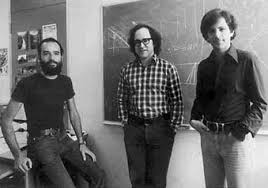 RSA: Ron Rivest, Adi Shamir, and Leonard Adelman.
The RSA public-key encryption scheme is based on the hardness of factoring integers. That is, given a composite integer $N$, find positive integers $p,q$ such that $pq=N$. The general idea behind RSA is that multiplying two large primes $p$ and $q$ together is very easy, but given their product $pq=N$, factoring $N$ is extremely difficult. After the creation of the $\textit{RSA Cryptosystem}$, other public-key cryptosystems followed. The most important of these public-key cryptosystems are RSA and its variations and the $\textit{ElGamal Cryptosystem}$ and its variations. As we just mentioned, the security of RSA is based on the computational infeasibility of factoring large integers, while ElGamal is based on the computational infeasibility of what is known as the discrete logarithm problem. A variation on ElGamal is known as elliptic curve cryptography (ECC) which is based on the algebraic structure of elliptic curves over finite fields.
Post Quantum Cryptography
Public-key encryption schemes such as RSA, ElGamal, and ECC have proved to be extremely effective and are used all over the world to ensure secure communication in situations where private-key cryptosystems are not sufficient. As mentioned before, RSA's security is based on the hardness of factoring integers while ElGamal and ECC are based on elliptic curves, and their security depends on the hardness of the discrete logarithm problem. Thus far, no one has found a classical polynomial time algorithm to factor integers or solve the discrete logarithm problem, and it is conjectured that no such algorithm exists [6]. This is not the case however in quantum theory.
In 1994 Peter Shor discovered quantum algorithms for factoring and discrete logarithms, now known as Shor's algorithm. Shor's algorithm can factor integers in polynomial time and it was further shown that Shor's algorithm could be applied to discrete logarithm problems and solve those in polynomial time as well. This means that as soon as a large quantum computer is developed, RSA, ElGamal, and related cryptosystems will no longer be secure, as they can be trivially broken using Shor's algorithm. No such quantum computer yet exists, but it is believed that a functional large quantum computer could be built within 20 years [1].
While the discovery of Shor's algorithm was certainly a blow to public-key cryptography, it is far from its death knell. Despite the fact that RSA and ElGamal will no longer be secure after a large quantum computer is built, there are many other cryptographic schemes that are believed to be secure against quantum attacks. Post Quantum Cryptography therefore, refers to the study of encryption schemes that are secure against attacks by quantum computers. Some post-quantum schemes are themselves quantum (i.e. utilize the principles of quantum mechanics), while others are classical schemes. Among the potential post-quantum encryption schemes is a cryptosystem called $\textit{NTRU}$, which is an example of what is known as lattice based cryptography. A post later in this intro to cryptography series will be devoted to explaining NTRU and exploring its security. Before we begin this discussion however, we will first need to explain some notions of $\textit{security}$ in the world of theoretical cryptography.
Part 2 of the series: Security
References
- Daniel J. Bernstein, Johannes Buchmann, and Erik Dahmen. Post Quantum Cryptography. 2009: Springer-Verlag, Berlin.
- Dan Boneh and Ramarathnam Venkatesan. (1998). Breaking RSA may not be equivalent to factoring. Advances in Cryptology - EUROCRYPT '98. Lecture Notes in Computer Science, Volume 1403, 59-71. Springer, Berlin.
- Shafi Goldwasser and Silvio Micali. (1982). Probabilistic Encryption & How to Play Mental Poker Keeping Secret all Partial Information. STOC '82 Proceedings of the fourteenth annual ACM symposium on Theory of computing (pp. 365-377). ACM, New York.
- Jeffrey Hoffstein, Jill Pipher, and Joseph H. Silverman. (1998). NTRU: A ring based public key cryptosystem. Lecture Notes in Computer Science, Volume 1423, 267-288. Springer, Berlin.
- Jeffrey Hoffstein, Jill Pipher, and Joseph H. Silverman. An Introduction to Mathematical Cryptography. 2008: Springer, N.Y.
- Jonathan Katz and Yehuda Lindell. Introduction to Modern Cryptography. 2007: CRC Press, N.Y.
- Vadim Lyubashevsky, Chris Peikert, and Oded Regev. (2010). On Ideal Lattices and Learning with Errors over Rings. In H. Gilbert (ed.), Advances in Cryptology - EUROCRYPT 2010 (pp. 1-23). Springer, Berlin.
- Phong Q. Nguyen and David Pointcheval. (2002). Analysis and Improvements of NTRU Encyption Paddings. In M. Yung (ed.), Advances in Cryptology - Proceedings of CRYPTO 2002 (pp. 210-225). Springer-Verlag, Berlin.
- Chis Peikert. A Decade of Lattice Cryptography 2016: Now Publishers.
- Damien Stehle and Ron Steinfeld. (2011). Making NTRU as Secure as Worst-Case Problems over Ideal Lattices. In K.G. Patterson (ed.), Advances in Cryptology - EUROCRYPT 2011 (pp. 27-47). Springer, Berlin.
- Ron Steinfeld et al. (2012). NTRUCCA: How to Strengthen NTRUEncrypt to Chosen-Ciphertext Security in the Standard Model. Lecture Notes in Computer Science, Volume 7293, 353-371. Springer, Berlin.
- Douglas Stinson. Cryptography Theory and Practice. 2002: CRC Press, Boca Raton.